
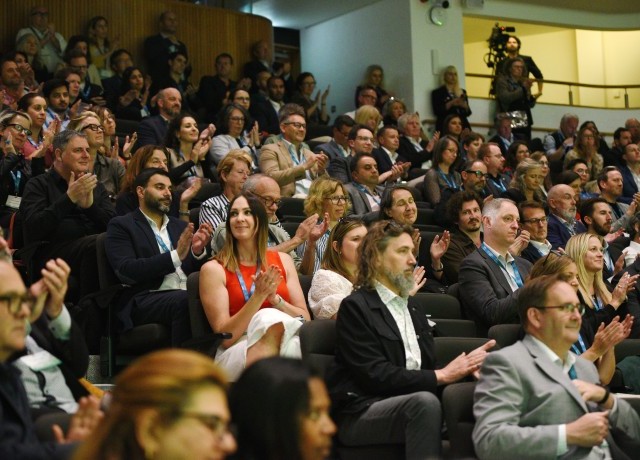
Knowledge + Innovation Theatre
The Knowledge + Innovation Theatre in the Exhibition and Poster Gallery at the Congress offers a dynamic programme of high-impact sessions exploring the intersection of design innovation, social value, and technology in healthcare environments.
Situated at the heart of the Knowledge Zone on the exhibition floor, the theatre provides an accessible platform for knowledge exchange between designers, clinicians, researchers, industry innovators, and health system leaders. Through a series of presentations, case studies, and interactive discussions, speakers will share practical insights into how thoughtful design and emerging technologies can improve patient experience, staff wellbeing, operational efficiency, and long-term system resilience.
Sessions will showcase real-world projects, technology and social innovations that demonstrate how healthcare environments can be shaped to deliver greater social value – supporting quality improvement in clinical care, and improvements in the patient environment.
These sessions encourage open dialogue and invite audience participation, enabling delegates to engage directly with presenters and explore how ideas can be translated into practice. The Knowledge + Innovation Theatre serves as a vibrant hub for inspiration, collaboration, and discovery throughout the Congress.
The full detailed agenda of talks and panels will be announced shortly.
Monday 15 June
Session overview
Abstract Copy
This session highlights emerging products, design approaches, and digital solutions shaping the future of healthcare environments. This fast-paced session will feature presentations from innovators, designers, manufacturers, and technology providers showcasing new ideas that enhance the interior and built environment of healthcare settings. Contributions will demonstrate how design and technology can improve patient experience, support clinical workflows, enhance staff wellbeing, and increase operational efficiency.Session overview
Abstract Copy
This session explores how healthcare design can respond to wider social challenges and support more inclusive, community-focused models of care. Drawing on UK and international examples, the session examines how healthcare systems can extend beyond traditional hospital boundaries to address social determinants of health, particularly for vulnerable and marginalised populations. It highlights approaches that integrate healthcare with housing, community services, and supportive environments, while also emphasising the importance of co-design and lived experience in shaping more welcoming, dignified spaces.
Emma Geoghegan

Tara McGinty

Aileen Igoe
Included by design: Learning from lived experience to shape inclusive healthcare spaces and services
Abstract Copy
The Inclusion Health team at the Mater Hospital, working in partnership with the Mater Transformation team, has been developing responsive, integrated models of care for people experiencing homelessness, a population with disproportionately high morbidity, accelerated ageing, and markedly reduced life expectancy. Evidence consistently highlights extremely high rates of preventable mortality, with many deaths arising from conditions treatable within mainstream healthcare. Yet access to care is frequently undermined by stigma, trauma, mistrust, and the complexity of navigating fragmented health and social systems. Consequently, many individuals struggle to sustain engagement and rely heavily on emergency services, with some presenting to hospital more than 20 times each year.In response, the team has developed innovative service models, pioneering in the Irish context, which integrate community-based supports directly into acute hospital care. These approaches aim to sustain engagement, improve continuity, and address overlapping clinical and social needs that frequently fall between traditional service boundaries. However, their effectiveness depends not only on how care is organised but also on where it is delivered. Conventional hospital environments, often highly clinical and institutional, can unintentionally reinforce stigma or re-traumatise people who have experienced long-term exclusion from healthcare. This has prompted growing recognition of the need for therapeutic, dignified, and inclusive environments that support relationship-centred, trauma-informed care.
To explore how the built environment might enable such care, the Inclusion Health team collaborated with fifth-year architecture students from the School of Architecture and Built Environment at Technological University Dublin. Students were tasked with reimagining an existing community-based building, scheduled for redevelopment, as a specialist healthcare hub for people experiencing homelessness. Central to this work was a co-design process involving people with lived experience of homelessness, addiction, and repeated engagement with acute hospital services. Through workshops, structured dialogue, and site visits, lived-experience contributors shared insights into what promotes, or undermines, feelings of welcome, trust and safety within healthcare settings.
These contributions directly shaped the students’ design proposals, challenging assumptions and deepening understanding of how inclusive, trauma-informed environments can be realised in practice. The resulting co-designed concepts, reflecting the voices and priorities of those most affected, will be presented. The presentation reflects on key insights from the collaboration, highlighting design principles grounded in lived experience that can inform future models of care for highly marginalised populations. It argues that thoughtfully designed environments are central to improving outcomes, reducing repeat hospital presentations, and enabling people to access and complete care successfully overall.
Learning Objectives
- Understand health inequities and systems of care Examine how this affects people experiencing homelessness, including trauma, stigma, fragmented systems, and built environment, and recognise how integrated inclusion-health models improve access and care
- Apply trauma-informed and inclusive design principles Identify how healthcare environments shape care and patient experience, and define trauma-informed, inclusive, and dignified design principles informed by lived experience and co-design.
- Understand collaborative and co-design approaches in inclusive healthcare: Recognise the value of co-design with people with lived experience, healthcare professionals, designers, architects and students in creating inclusive and sustainable care models

Kerri Culver

Andrew Boozary MD
Social Medicine Housing Initiative (Dunn House)
Abstract Copy
Homelessness is a profound public health crisis associated with reduced life expectancy, accelerated ageing, high rates of co-morbidity, and disproportionate use of emergency and inpatient care. At the University Health Network (UHN) in Toronto, the top 100 patients without fixed addresses accounted for more than 4309 emergency department visits in a single year, highlighting the limits of hospital-based care alone and housing as a core determinant of health. In response, UHN developed the Social Medicine Housing Initiative at 90 Dunn Avenue (Dunn House), Canada’s first hospital-led permanent supportive housing model with on-site health and social services to improve health outcomes and quality of life for chronically unhoused, medically and socially complex patients.The initiative is a partnership between UHN’s Gattuso Centre for Social Medicine, the City of Toronto, United Way Greater Toronto, and Fred Victor. Opening in late 2024, Dunn House prioritises unhoused UHN patients who are among the highest users of emergency and inpatient services. Tenants are cross-referenced with the City’s homelessness registry and selected based on medical complexity, social vulnerability, and homelessness duration, with particular attention to women, Indigenous peoples, and people with disabilities.
The four-storey building contains 51 studio apartments, each 275 square feet with a kitchenette and private bathroom; 15 units are fully barrier-free. Fred Victor operates the building and provides wraparound supports, including case management; housing stabilisation; daily meals; mental health; harm reduction services; personal support worker assistance; justice and system navigation; and community integration programming. Residents also benefit from shared communal spaces, a community garden and on-site commercial kitchen supported by United Way Greater Toronto.
Dunn House demonstrates that stable housing is critical to patient recovery and health equity. By integrating permanent housing with healthcare and community-based supports, the initiative establishes a scalable model for addressing homelessness among vulnerable populations and alleviating strain on acute-care systems.
Constructed using modular building techniques, it minimised construction waste, noise, and emissions while accelerating delivery on constrained urban land. It incorporates sustainable features such as a green roof for insulation and rainwater filtration, energy-efficient systems, and the Bonnie Storr Garden – an outdoor space designed to foster biodiversity and resident wellbeing. The layout prioritises accessibility, community-engagement, and person-centred care, blending healthcare delivery with housing stability.
Externally, it aligns with contemporary residential design strategies, which emphasise open, connected spaces and adaptive reuse of historic elements – a philosophy mirrored in Dunn House’s modular adaptability and community-centric planning.
Learning Objectives
- Access to Housing significantly reduces ER visits and improve outcomes.
- Prefab can increase the availability of rapid housing initiatives and still foster community.
- Designing for Patient centered outcomes.
Tuesday 16 June
Session overview
Abstract Copy
This session explores how healthcare environments can better support people of all ages, abilities, and cognitive needs through thoughtful architectural design. Presentations will demonstrate how inclusive design strategies can enhance orientation, independence, and patient experience
Vittoria Falchini

Rosi Pachilova
From fragility to cognitive resilience: A neurodesign framework for age-inclusive hospital design
Abstract Copy
As global populations age, healthcare environments must transition from merely mitigating physical decline to actively fostering cognitive resilience, autonomy, and wellbeing. The European Healthcare Design 2026 theme, “Agile not Fragile,” calls for design approaches that enable renewal rather than reinforcing vulnerability. This paper proposes a neurodesign-informed framework for hospital environments enhancing cognitive resilience in older adults through sensory clarity, emotional anchoring, meaningful engagement, and navigational confidence.Grounded in neuropsychology, we examine ageing-related changes affecting perception, spatial cognition, hormonal transitions (particularly post-menopausal neurocognitive shifts), gender-related movement and navigation preferences, and dementia-related impairments in wayfinding, memory, and environmental recognition. We identify how these behavioural and neural changes influence environmental interpretation across signage, colour perception, material tactility, symbolic cues, and emotional resonance.
A review of architectural and healthcare design research demonstrates that signage legibility, chromatic contrast, artwork and greenery, and material familiarity significantly influence older adults’ ability to navigate spaces, reduce stress, and maintain agency. However, many design strategies treat elderly users as fragile recipients rather than cognitively active individuals capable of environmental co-adaptation, emotional interpretation, and self-directed exploration.
To explore lived experiential responses, a qualitative VR study was conducted in collaboration with an elderly charity, exposing participants to alternative hospital lobby scenarios. Semi-structured interviews focused on wayfinding clarity, emotional responses to nature, the reassuring or unsettling presence of people, and the interpretive impact of artwork. Participants preferred environments softened by artwork, which made spaces feel less institutional and more reassuring. Greenery was valued as an orienting and calming element, though excessive planting was overwhelming, indicating restorative cues must be balanced with spatial clarity. Participants responded positively to design elements perceived as intentional, such as sculptures with symbolic purpose rather than merely decorative. Importantly, participants emphasised retaining autonomy “as much as they can,” indicating design should support not only comfort and clarity but also self-efficacy and volitional movement.
Drawing from these findings, we introduce a conceptual matrix for resilient neurodesign in healthcare environments for older adults. The framework maps (1) cognitive needs (orientation, continuity, meaning, autonomy), (2) neuropsychological responses (attentional stability, procedural memory activation, emotional reassurance, stress reduction), and (3) design strategies (colour hierarchy, sensory cues, purpose-driven landmarks, transitional anchors, biophilic familiarity).
The paper concludes by positioning this approach as a shift from compensatory ageing design to cognitive resilience architecture supporting dignity, agency, and adaptive capability in later life, fully aligning with the ethos of “Agile not Fragile.”
Learning Objectives
- Understand ageing-related cognitive and perceptual changes and their implications for healthcare design.
- Apply neurodesign principles to create hospital environments that enhance cognitive resilience and autonomy.
- Evaluate the impact of environmental elements on older adults’ wellbeing and spatial experience.

Smeya Shirley Deborah Prince Jawahar

Todd Accardi
Beyond signage: The impact of architectural elements as wayfinding anchors in healthcare settings
Abstract Copy
This research investigates the integration of wayfinding principles into the early stages of healthcare design, with a focus on reducing reliance on signage and enhancing intuitive navigation, particularly for patients unfamiliar with the environment. Traditional wayfinding strategies are often introduced during the later design phases, emphasising signage, coloured walls, and supergraphics. However, this study explores the potential of embedding wayfinding strategies within spatial planning to determine whether a healthcare facility can support self-navigation based on spatial heuristics rather than external cues.Addressing the phenomenon of "wayfinding/spatial anxiety," the study examines how individuals, especially those with low spatial confidence, experience the space when navigating complex healthcare environments. Behavioural responses to disorientation in healthcare settings can negatively affect both the patient experience and operational efficiency. The research focuses on five spatial design elements: 1) visibility of team/nurse stations; 2) access to daylight and exterior views; 3) the impact of route complexity (number of turns); 4) preference for linear versus branching corridors; and 5) orientation upon exiting elevators.
Using a combination of observational studies and user surveys (n=104), this study assessed the influence of these elements on wayfinding behaviour and user confidence. Results revealed that 55 per cent of users preferred visible team stations for improved orientation, with first-time and male visitors expressing stronger preferences. Daylight also proved to be a key navigational cue, with 71 per cent of users reporting improved orientation in naturally lit corridors, especially women and first-time visitors. Elevator lobbies emerged as significant points of confusion, with 59 per cent of users pausing to reorient and 77 per cent of first-time visitors reporting disorientation. Contrary to initial assumptions, route distance and turn frequency were less influential than spatial clarity and visual cues.
Design takeaways from the study emphasise the importance of placing visual landmarks in lines of sight, integrating daylight into primary circulation paths, simplifying corridor layouts, and improving elevator lobby clarity. These strategies support intuitive navigation and reduce spatial anxiety. Ultimately, this research reinforces the need to prioritise wayfinding in architectural planning, not as a secondary feature but as a core design principle that enhances user autonomy, reduces stress, and contributes to more humane, user-centred healthcare environments.
Learning Objectives
- 1. Create data-driven recommendations that can help architects and designers optimize hospital layouts to reduce stress and confusion for patients.
- 2. Investigate how various design elements, such as daylight, the placement of team stations, corridor configurations, and elevator exits, contribute to intuitive navigation.
- 3. Synthesize research findings to propose evidence-backed design strategies that improve wayfinding in hospital environments, focusing on spatial planning rather than signage.
Session overview
Abstract Copy
This session explores how innovative design thinking and architectural practice are supporting the transformation of healthcare delivery. Through two international panel discussions the session will consider how healthcare environments are evolving to respond to changing clinical models, integrated care systems, and new approaches to patient-centred services. Speakers will reflect on lessons from recent projects and emerging trends in healthcare planning and design, highlighting how flexible, resilient, and human-centred environments can enable new ways of delivering care.Session overview
Abstract Copy
This session explores how innovative planning strategies, technologies, and new products are shaping the design and performance of healthcare environments. Through a series of short, fast-paced presentations, contributors will share ideas, projects, and emerging solutions that support more efficient clinical workflows, improved patient experiences, and adaptable healthcare spaces. Topics may include healthcare planning approaches, advances in medical equipment, digital systems, and design innovations for the interior and built environment.