
Keynote summary: Estate transformation key to community-based care, NHS boss proclaims
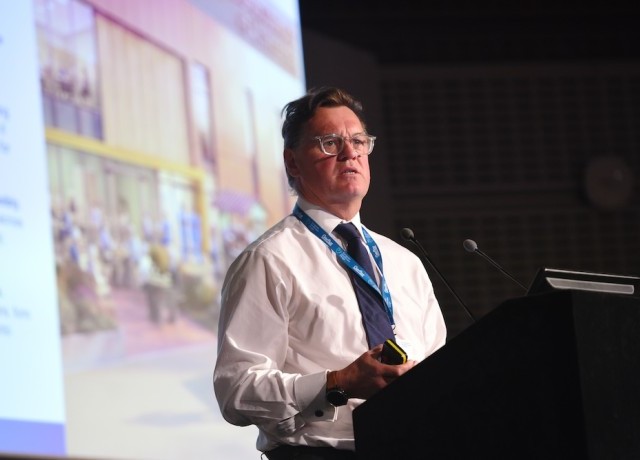
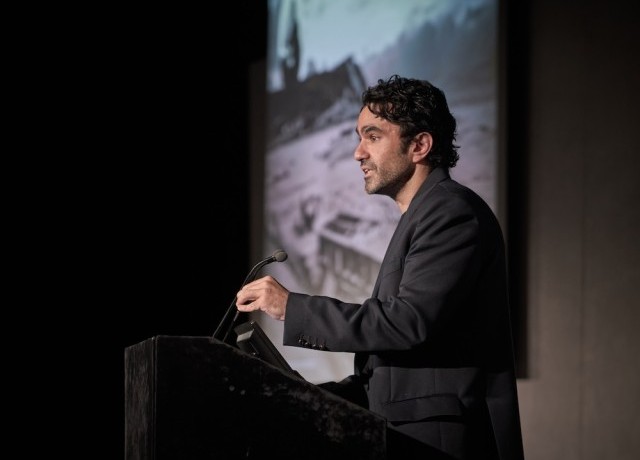
The National Health Service must undertake a once-in-a-generation transformation of its estate if it is to deliver the UK government's ambition of shifting care from hospitals into communities, according to Simon Corben, director and head of profession for NHS Estates and Facilities.
Addressing delegates at the European Healthcare Design 2026 Congress, Corben outlined an ambitious vision for modernising NHS infrastructure, supported by unprecedented long-term capital investment, new neighbourhood health centres and a more strategic approach to estate planning.
His central message was clear: the future of healthcare will not be built through ever-larger hospitals, but through a network of community-based facilities designed to keep people healthier and closer to home.
“We cannot continue to build new hospitals,” Corben said. “We need to replace hospitals, absolutely. But do we need larger hospitals? No.”
Corben began by highlighting the sheer scale and complexity of the NHS estate. The organisation manages approximately 24 million square metres of infrastructure spread across almost 30,000 buildings, including GP practices, and serves around 1.7 million patients every day. Many of those facilities are ageing, creating major challenges for maintenance, modernisation and service delivery.
Despite these constraints, Corben praised the sector’s ability to adapt. Reflecting on the Covid-19 pandemic, he argued that while emergency Nightingale hospitals received much of the public attention, less recognised was the extensive work carried out within existing hospitals to increase resilience.
“We increased oxygen capacity by about 30,000 beds across the NHS,” he said, describing it as an extraordinary achievement by estates and infrastructure teams.
Corben also pointed to what he described as a historic shift in government thinking on capital investment. After years of short-term funding cycles, the NHS now has access to a ten-year infrastructure strategy, providing greater certainty and enabling long-term planning. The strategy includes plans for £119 billion of capital investment over the next decade, including £24 billion for the New Hospital Programme. Around £6.75 billion has been allocated specifically to infrastructure safety improvements.
For Corben, the significance lies not only in the scale of funding but in the ability to make strategic decisions across regions, balancing immediate maintenance needs with future transformational projects. “To have that foresight for ten years is a real opportunity for us as a community to plan in a sensible way,” he said.
We cannot continue to build new hospitals. We need to replace hospitals, absolutely. But do we need larger hospitals? No.


A major element of that transformation is the NHS Neighbourhood Health Centre Programme. Corben outlined plans to develop 250 neighbourhood health centres by 2035 through a public-private partnership programme valued at between £4.5 billion and £5 billion. The centres are intended to become the physical foundation of the NHS’s “left shift” strategy, moving services away from acute hospitals and into local communities.
Supporting that ambition is a growing emphasis on standardisation and digital planning tools. Corben highlighted the development of the NHS’s estate intelligence platform, now known as Strata, which brings together property and infrastructure data from across the health service.
Artificial intelligence is also beginning to play a role. Corben described how AI-powered tools could help planners identify which buildings are most suitable for conversion into neighbourhood health centres and assess the wider impact of estate decisions across healthcare systems.
“We’re starting to ask really intuitive questions about our portfolio,” he said, “ such as what buildings would adapt themselves quite easily and readily into a neighbourhood health centre? What impact would that have on other services across the region?
What investment would I need?”
One of the more innovative aspects of the strategy involves repurposing vacant high street properties. Corben said the NHS is working with local authorities and central government to convert empty retail spaces into healthcare facilities, helping to revitalise struggling town centres while improving access to care.
The NHS, he argued, can act as an “anchor tenant”, generating footfall and stimulating local economic activity. “We will regenerate that entire area,” he said. “We will have significant footfall to that area. We will become that anchor tenant.”
Corben also outlined plans to increase standardisation in healthcare design and construction. New design guides, standardised templates and adaptable building models are intended to accelerate delivery while improving consistency and reducing costs.
The NHS has already demonstrated its ability to extract more value from existing assets, he noted. Over the past eight years, the service has effectively created the equivalent capacity of five large hospitals by converting non-clinical space into clinical areas. However, he cautioned that further gains from squeezing existing estates are becoming harder to achieve.
Instead, future improvements depend on reducing pressure on acute hospitals by shifting patients into community settings. As hospital demand becomes increasingly concentrated among the sickest and most complex patients, acute facilities can be redesigned to focus on high-acuity care.
Alongside expansion of community facilities, Corben called for greater investment in infrastructure resilience, sustainability and lifecycle management. He argued that infrastructure failures increasingly have a direct impact on productivity and patient care, helping to explain why estates investment has gained greater prominence in recent government spending decisions.
Ultimately, Corben framed the NHS estate strategy as a critical enabler of wider healthcare reform. Success, he said, would be measured by its ability to support three overarching policy goals: shifting care from hospitals into communities, moving from treatment to prevention, and accelerating the transition from analogue to digital services.
“What we want,” he concluded, “is an estate that improves care and addresses the population that we’ve got coming forward.” The challenge now, he suggested, is turning an unprecedented long-term investment programme into tangible improvements for patients and communities across the country.
Presenters

Event news




Actions to improve urban renewal and health equity
2nd September 2024
A vision for Liverpool: Putting people’s health first
2nd September 2024
Investing in urban renewal and health equity
21st March 2024
Health equity: Marmot Cities
20th March 2024