
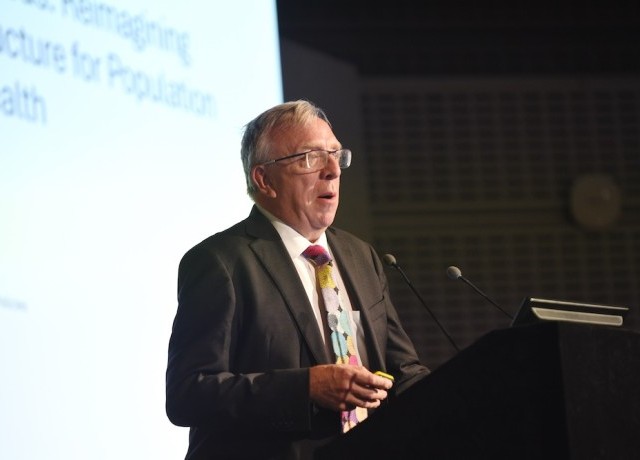
Keynote summary: Population health shift will redefine future of hospitals, policy expert warns
Hospitals across Europe face a fundamental redesign as healthcare systems increasingly embrace population health approaches, according to healthcare policy expert Nigel Edwards, speaking at the European Healthcare Design 2026 Congress.
In a keynote address focused on the implications of population health for hospital planning and design, Edwards argued that while much attention has been paid to prevention, community care and data-driven health management, the consequences for hospitals themselves remain insufficiently explored.
At the heart of his message was a stark reality: a relatively small proportion of patients account for a disproportionately large share of healthcare demand. In the UK, he noted, around 46 per cent of hospital activity is generated by just 7 per cent of the population. Meanwhile, only 3 per cent of people who are frail or living with multiple long-term conditions account for 25 per cent of emergency admissions and use emergency departments four times more frequently than average.
Much of this could be addressed, asserted Edwards, “through better prevention, stronger primary care and alternative models of care”. He argued, too, that healthcare systems are being driven towards population health models by rising chronic disease, ageing populations and a contraction in healthy life expectancy. People are living longer but spending more of those additional years in poor health, creating increasing pressure on hospitals.
Edwards highlighted the role of modern data analytics and artificial intelligence in enabling a more proactive approach. The ability to combine data from primary care, hospitals, prescribing systems and social care allows health systems to identify high-risk patients and target interventions before crises occur.
However, he stressed that successful population health management depends on strong primary care, multidisciplinary teams and closer integration between health and social care services. Addressing social determinants such as isolation, unemployment and poor housing is increasingly important in reducing demand on healthcare systems.
The implications for hospitals could be profound. One anticipated benefit is a reduction in avoidable emergency department attendances. Edwards suggested that as many as 40 per cent of emergency department visits in the UK – and in some cases up to 50 per cent in Spain – could potentially be managed through primary care or community-based alternatives.
Rather than dramatically reducing admissions, he suggested population health strategies are more likely to “bend the curve” of future demand growth, slowing the increase in hospital activity rather than reversing it.
A major opportunity lies in reducing hospital length of stay. Edwards criticised the UK’s long-standing failure to adequately fund social care, which leaves many patients occupying acute hospital beds despite no longer requiring hospital treatment. Countries such as the Netherlands and those in Scandinavia, which invest more heavily in community and social care, experience far fewer delayed discharges.
“Most patients staying beyond seven days could potentially be cared for elsewhere if the right services existed,” he said. Yet Edwards warned, too, that reducing long-stay patients creates new operational challenges. If hospitals continue to target very high occupancy rates, they may become overwhelmed during peak daytime periods despite appearing efficient on paper. Lower occupancy targets, more flexible spaces and greater use of single rooms may be needed in future hospital designs.
The starting point is not how many beds you need. The starting point is how you create the capacity and ability to manage population health


He also predicted significant changes to the role of hospital specialists. Rather than relying on traditional outpatient appointments, specialists will increasingly provide advice, guidance and teleconsultations to primary care teams. This shift could reduce unnecessary clinic visits while allowing patients with chronic conditions to be managed closer to home.
The traditional outpatient department, Edwards suggested, could become substantially smaller, focusing primarily on procedures that genuinely require face-to-face care.
Virtual wards are another growing trend. Rather than placing patients in hospital beds, healthcare systems are increasingly supporting them at home through remote monitoring and coordinated clinical oversight. Edwards cited examples from England where virtual ward capacity is expanding rapidly and becoming a significant component of overall healthcare provision.
Despite enthusiasm for shifting care into communities, Edwards challenged assumptions that centralisation is always the answer. While evidence supports concentrating some specialised surgical services, he argued there is little evidence that centralising general medical services improves outcomes.
“The answer to everything isn’t centralise it,” he said, warning that larger hospitals can become dangerously congested and that transferring patients carries risks of its own.
Looking ahead, Edwards raised unanswered questions about how future hospitals should be designed to remain resilient during pandemics and major incidents while operating with fewer beds and more decentralised services.
He concluded by urging healthcare leaders and designers to think beyond buildings and bed numbers. “The starting point is not how many beds you need,” he said. “The starting point is how you create the capacity and ability to manage population health.”
While implementing population health models will require a major cultural shift for healthcare organisations, Edwards expressed optimism that hospitals will continue to play a central role in healthcare systems – albeit one very different from the institutions of today. Predictions of the hospital’s demise, he concluded, remain greatly exaggerated.
Presenters

Event news





Actions to improve urban renewal and health equity
2nd September 2024
A vision for Liverpool: Putting people’s health first
2nd September 2024
Investing in urban renewal and health equity
21st March 2024
Health equity: Marmot Cities
20th March 2024