
Cancer centres must evolve as treatment shifts beyond hospital walls, report warns
Cancer centres need a fundamental rethink as patients live longer with increasingly complex conditions and more treatment moves out of hospitals and into homes and communities, according to a new international foresight report.
Cancer centres need a fundamental rethink as patients live longer with increasingly complex conditions and more treatment moves out of hospitals and into homes and communities, according to a new international foresight report.
The document, ‘Design Horizons: The Cancer Centre as the Caregiver’, produced by international design practice Hassell in partnership with VA Sciences, argues that many cancer facilities remain designed around an outdated assumption: that patients will move predictably through a fixed treatment pathway.
Instead, cancer care is becoming longer, more complex and more personalised, while digital health and community-based treatment are changing who needs to come to hospital and what they need when they get there.
The report says architecture and engineering should play a more active role in improving patient experience and clinical outcomes while making cancer facilities more adaptable, environmentally sustainable and resilient to climate change.
No longer a ‘typical’ cancer patient
Rising cancer incidence and longer survival are changing the demands placed on treatment facilities. Cancer care is shifting from episodic treatment towards continuous and increasingly complex care, with patients presenting at higher levels of acuity and experiencing longer and less predictable treatment journeys.
At the same time, lower-acuity treatment is increasingly being delivered outside hospital, meaning patients who do require admission can be sicker, more vulnerable and more dependent on their physical surroundings.
The profile of cancer patients is also changing. People are being diagnosed younger, populations are ageing, and many patients are managing cancer alongside multiple chronic conditions.
Increasingly personalised treatments add another layer of complexity: some patients may need longer stays while others spend less time in hospital, and a patient’s level of acuity can change during a single admission.
The report argues cancer centres must therefore be designed so spaces can support one type of care today and a different one tomorrow.
“Cancer care asks a lot of people – physically, emotionally and clinically,” Hassell sustainable design leader Sian Willmott said. “The next generation of cancer centres needs to give comfort, resilience and holistic support, no matter the level of acuity.”
Hospital no longer the only centre of care
Digital health is also eroding the traditional boundary between hospital and home. Tele-oncology, remote monitoring, AI-supported diagnostics and hospital-in-the-home models mean cancer centres are increasingly becoming one part of a broader network of care rather than a standalone destination.
The report argues digital infrastructure should consequently be treated in much the same way as core building infrastructure, alongside essential power, HVAC and medical-gas systems.
That could mean purpose-designed tele-oncology suites, remote-monitoring hubs and clinician workspaces backed by resilient networks, protected power supplies, cybersecurity and high-quality working environments.
The result would be a cancer centre capable of simultaneously delivering complex physical care and co-ordinating treatment being provided elsewhere.
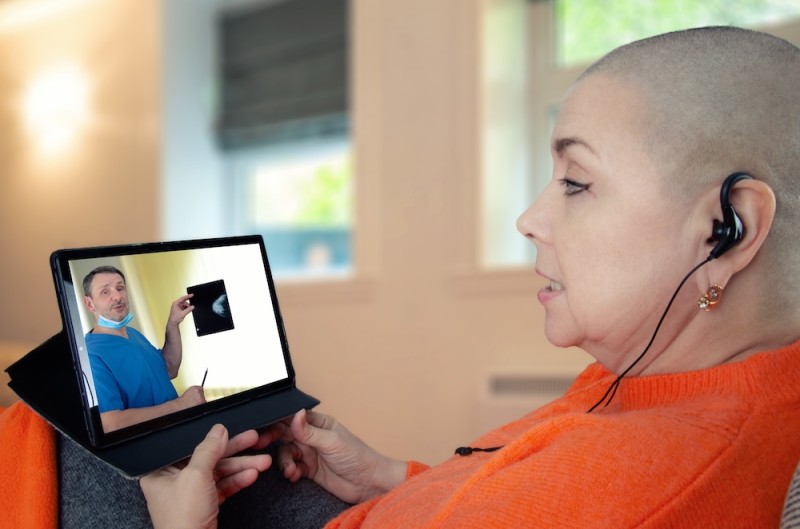 Cancer centres will need infrastructure that supports both in-person treatment and increasingly distributed models of care, allowing clinicians to co-ordinate and monitor patients beyond hospital walls
Five changes
The report identifies five major design shifts it says could prepare cancer facilities for the changing demands.
Design for longer stays: As lower-acuity patients increasingly receive care at home or in community settings, inpatient facilities will need to better serve those requiring prolonged hospital treatment.
The report proposes fewer, larger and more home-like rooms designed to be occupied for days or weeks rather than hours, providing space for family members, treatment, mobility and patients’ personal belongings.
Natural light, acoustic control, low-stimulus environments, access to nature and individual control over environmental conditions could help transform hospital rooms into more restorative places for patients undergoing prolonged treatment.
Prepare for higher-acuity patients: Rooms should be capable of responding quickly when a patient’s condition deteriorates without requiring relocation as the default option.
That means providing spare capacity for power, medical gases, monitoring and digital infrastructure, as well as adaptable ventilation and pressure controls.
Rooms could remain calm and restorative during normal use while having the capacity to “step up” to more intensive clinical care when required.
Make digital health part of the building: Cancer centres will need infrastructure that supports both in-person treatment and increasingly distributed models of care, allowing clinicians to co-ordinate and monitor patients beyond hospital walls.
Break down clinical silos: Cancer treatment increasingly intersects with geriatrics, chronic disease management, rehabilitation, supportive care and research.
The report calls for a shift from isolated departments towards integrated care environments, with shared consultation and treatment spaces and stronger links between diagnostics, therapies and research.
Spaces designed to support multiple specialties could also make facilities more adaptable as clinical needs change.
Build for a changing climate: Cancer centres must remain safe and operational during heatwaves, smoke events, power disruptions and other environmental shocks.
The report recommends passive-first design, high-performing building envelopes, cleaner-air strategies, resilient engineering systems and designated refuge areas to protect vulnerable patients while reducing energy demand.
Landscape should also be considered part of the facility’s infrastructure, with trees, shaded outdoor spaces and planted areas helping to manage heat, stormwater and air quality while providing therapeutic benefits.
“The collaboration between architects and engineers is paramount, so facilities can flex across different scenarios without compromising patient care” – Sian Willmott, Hassell


Designing for decades
The report argues achieving these changes will require governments, health planners, architects and engineers to work together earlier in the development of new and refurbished facilities.
Operational flexibility, digital requirements and infrastructure resilience should be considered during project briefing and business-case development rather than being addressed later.
“The collaboration between architects and engineers is paramount, so facilities can flex across different scenarios without compromising patient care,” Willmott said.
Modular spaces, scalable infrastructure and spare servicing capacity could allow hospitals to adapt as patient needs, technologies and models of care change, reducing the cost and disruption associated with major refurbishments.
Climate change adds further urgency, with increasingly unpredictable energy and environmental conditions placing additional pressure on healthcare infrastructure.
Ultimately, the report argues the future cancer centre should be viewed not simply as a building but as an adaptable, digitally enabled and climate-responsive “care platform” capable of supporting patients, staff and communities over decades of change.
Its research combined targeted expert interviews with a review of published information. Interviews with Hassell global health sector lead Leanne Guy and VA Sciences director Simon Witts examined changing models of care, patient and staff experience, operational demands and broader environmental and social pressures, supplemented by research into emerging evidence on cancer prevalence and climate change.
The report was developed through Hassell’s Design Horizons foresight platform, which examines how the design industry may need to evolve in response to challenges facing people and the planet.
Event news
EHD 2026 Awards: Winners revealed
12th June 2026
Actions to improve urban renewal and health equity
2nd September 2024
A vision for Liverpool: Putting people’s health first
2nd September 2024
Investing in urban renewal and health equity
21st March 2024