
Future healthcare needs demand more than new hospitals, report argues
Health systems must rethink how and where they deliver care before committing to new hospitals, according to a report warning that construction alone cannot keep pace with growing demand.
Demanding a digital design, published by KPMG and Hassell, argues that infrastructure decisions made today risk locking services into hospital-centred care for decades. Its central message is that future health needs should determine what gets built, with digital services, workforce planning and care models developed together from the outset.
Understanding the challenge
Australia’s health services face demand that is growing faster than the population, alongside increasingly complex patient needs. Over the past decade, population growth of 16 per cent was accompanied by an average 24-per-cent increase in hospital and Medicare specialist activity, the report says.
Rising construction costs and workforce shortages limit how quickly additional hospital capacity can respond. Meanwhile, people living longer with chronic conditions need sustained, co-ordinated support that hospital-based services alone struggle to provide.
Virtual care offers one alternative. The report cites an evaluation of Australia’s MeCare programme for frequent health service users with chronic illness, which reported 50-per-cent fewer hospital admissions and net savings of AU$982 per participant per month.
Such results relate to particular programmes and patient groups, however. Extending the benefits requires co-ordinated funding, staffing, workflows and infrastructure. Adding technology to existing services is insufficient if the underlying organisation of care remains unchanged.
Changing the default response
The report calls for hospitals to be planned as part of a wider care network, recognising that their location and design shape the movement of patients, staff and resources for generations.
Current investment processes can work against that ambition. Funding commitments may precede detailed service planning, while activity-based funding rewards treatment volumes more directly than prevention or reduced need. Separate decisions about buildings, technology and staffing can reinforce fragmented services.
The proposed response is to establish how care should operate before fixing the physical design. Clinical pathways, workforce requirements and digital capabilities should be developed together, supported by simulation and testing of alternative approaches.
This would leave the least reversible decisions until later. A building’s structure may endure for a century, while technologies and care models change much faster. Infrastructure should therefore enable future services rather than force them to fit assumptions embedded in an earlier brief.
Designing future-ready infrastructure
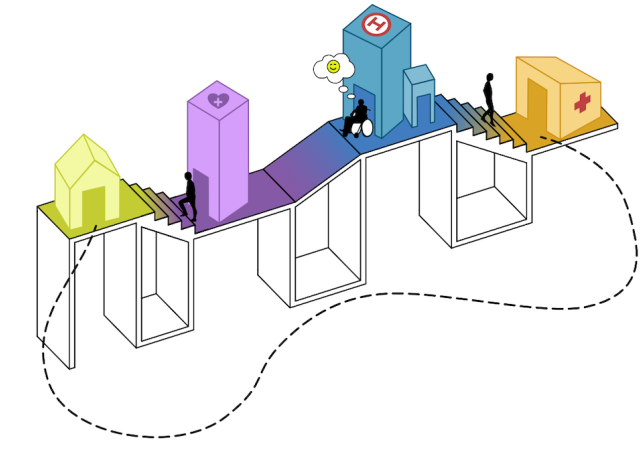
The report envisages four connected settings: patients’ homes, local community facilities, virtual clinical workplaces and an acute hospital core.
Appropriate care would move closer to home, while hospitals concentrate on complex, high-acuity and procedural work. Community facilities would provide examinations, diagnostics and support for accessing remote expertise where home care is unsuitable.
Each setting needs its own combination of technology, staff, workflows and governance. Shared information and clear clinical responsibility would help patients experience continuity across the network. Clinicians delivering remote care also need properly designed workplaces.
The report concludes with five principles: use evidence to establish need and local circumstances to shape solutions; match care with the right place and delivery method; make digital the default while ensuring human interactions count; give patients greater control over their care; and design digital workplaces that support clinicians.
Together, these principles suggest a different test for investment: whether infrastructure enables accessible, co-ordinated care and can adapt as needs change. Meeting future demand depends on the services that buildings make possible as much as the capacity they contain.
Event news


Actions to improve urban renewal and health equity
2nd September 2024
A vision for Liverpool: Putting people’s health first
2nd September 2024
Investing in urban renewal and health equity
21st March 2024
Health equity: Marmot Cities
20th March 2024