Glasgow’s new front door – Parkhead Integrated Health and Care Hub
Abstract
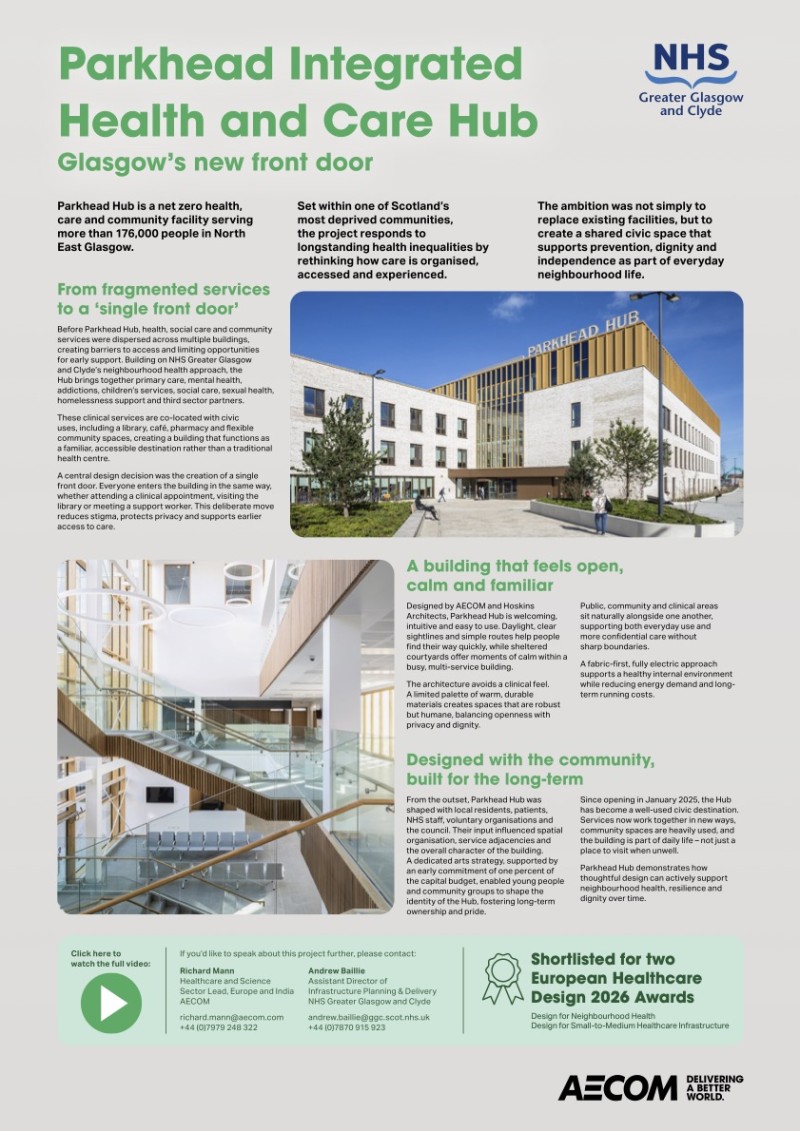
Northeast Glasgow is one of Scotland’s most disadvantaged urban areas, with persistent health inequalities, lower healthy life expectancy, social isolation and poorer quality-of-life outcomes. To transform the assessment and delivery of health and social care services, a new model of service delivery was needed. It was clear early intervention, prevention and harm reduction would provide greater self-determination and choice, shifting the balance of care and enabling independent living for longer across Northeast Glasgow.
Parkhead Hub was conceived not simply as a healthcare building but as social infrastructure supporting healthier lives through integrated access to care, advice, social support and community connections.
By bringing together services that address the wider determinants of health – including homelessness, addictions, criminal justice, mental health and social care – Parkhead Hub enables people to meet in the cafe, access support in one familiar, local setting, reducing barriers to care and supporting more equitable outcomes. Through a highly efficient, adaptable building design and by locating multiple services within a single, walkable destination, the project reduces travel demand, supports local access and contributes to lower-carbon models of care.
The building design took the next step in evolving the health hub model pioneered by NHS Greater Glasgow and Clyde. Its location at the heart of the community allows visitors to access the multiple services through the single front door. The single front door being a conscious choice, anonymising many of the vital caregiving services to support the entire community: reducing stigma, improving dignity, and encouraging access to support at earlier stages of need.
The design embodies a deep commitment to community collaboration throughout both planning and construction. Patients, local residents, voluntary organisations, councils, and NHS staff actively co-created the Hub, shaping everything from spatial adjacencies to material choices. Young people and community members also played a central role in developing an art strategy that personalises the building and fosters a sense of ownership.
This was supported by an early decision to allocate 1 per cent of the capital budget for this purpose. These extensive consultations ensured the Hub was co-created with the users and staff.
Since opening in January 2025, Parkhead Hub has demonstrated how integrated, community-based infrastructure can improve access, reduce stigma and support healthier urban communities. The project offers a replicable model for how health, social care and civic services can be brought together to address inequality, strengthen neighbourhood resilience and support healthier city living.
Learning objectives
- Neighbourhood health infrastructure can be a catalyst for wider urban regeneration
- Non-stigmatising civic environment can transform access to support
- Net-zero, low-carbon community facilities can also deliver healthier cities
Event news

Prototyping the high street integrated care hub (HICH)
2nd November 2026
Agile health: Social medicine by design
2nd November 2026
Braver not bigger: A new vision for health
2nd November 2026